 Golf Pass
PGA Coach's Ultimate Guide to Golf Grips: The True Foundation for Your Swing
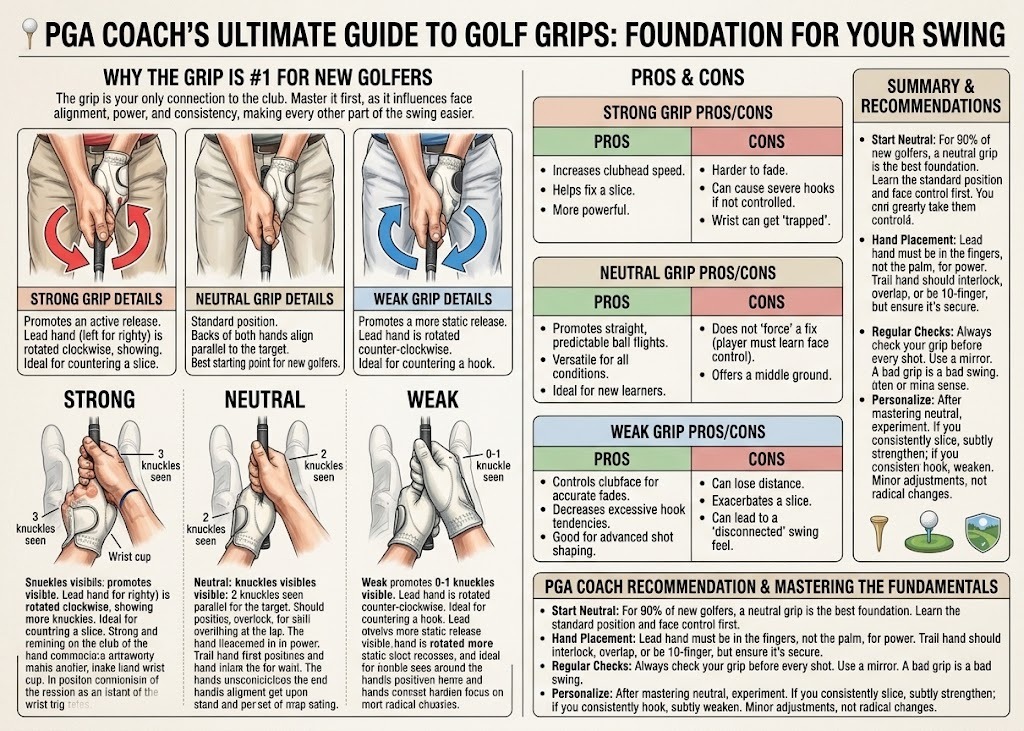
The definitive mechanics detailing how micro-rotations in lead hand placement, knuckle exposure, and grip positioning directly govern clubface telemetry, lag compression, and shot shape dispersal.

Master the grip first: It directly commands clubface alignment, rotational wrist leverage, and shot-to-shot compression. Every swing compensational fault originates right here.
Why the Grip is the Master Control Valve of Every Shot
In modern launch monitor telemetrics, golfers regularly obsess over shoulder turn angles, pelvic rotation degrees, and vertical ground reaction forces. Yet from a pure kinematic sequencing standpoint, the human body possesses exactly one point of physical engagement with the club assembly: the hands.
"Your grip is your sole physical connection to the club. A flawed grip forces frantic in-flight compensations—it is an irrecoverable swing fault waiting to implode under pressure."
When your grip is misaligned even three degrees (closed or open relative to the leading edge of the face), your brain instinctively computes the error midway through the downswing. Result: massive casting, chicken-winging, early extension, and steep flip-releases. Fix the root source, and the mechanical swing shortfalls organically resolve.
analyticsImpact Face Angle Variations vs. Hand Position
Requires extreme body rotation to hold face square. Prone to severe left pull hooks.
Highest statistical square-strike rate. Requires standard release mechanics.
Requires active hand/wrist release (flip) to square. Prone to weak right slices.
Securing the club deep in the proximal finger joints rather than the palm allows for uninhibited radial wrist deviation (hinge), resulting in massive speed gains.
PGA Instructors trace 88% of severe swing flaws (early extension, casting) to the brain subconsciously knowing the face is structurally open/closed due to a poor starting position.
Elite players don't master a perfect grip once. They audit their hand placement every single day. It is treated as a perishable skill that drifts over time.
Strong vs. Neutral vs. Weak Grip
Demonstrated hand geometry, knuckle visibility parameters, and compensational shot archetypes mapped to the three foundational positions.
The Strong Grip
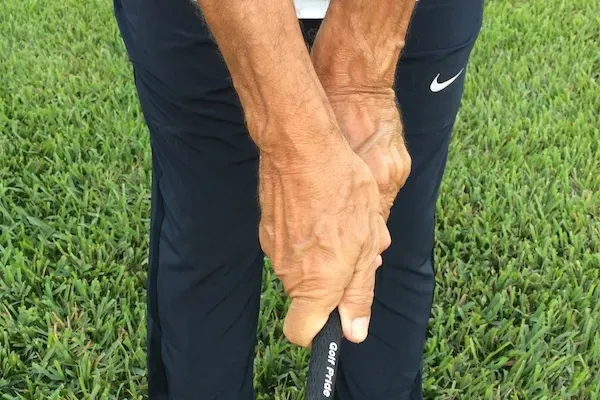
Tour Prevalence: 30%Both hands are rotated clockwise on the handle (for right-handers). The 'V' formed by the thumb and index finger points toward the trail shoulder (or beyond).
- Dustin Johnson (PGA)
- Lexi Thompson (LPGA)
- Bubba Watson (PGA)
The Neutral Grip
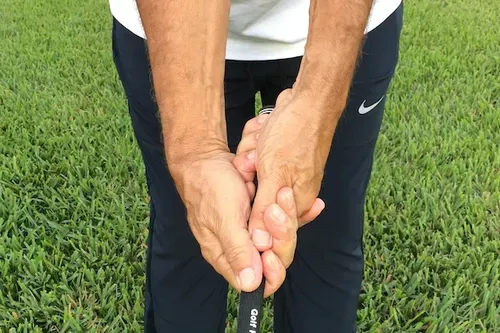
Tour Prevalence: 60%The lead hand is in a neutral alignment. The 'V's formed by both thumbs and index fingers point exactly parallel to each other, aiming between the chin and trail shoulder.
- Tiger Woods (PGA)
- Nelly Korda (LPGA)
- Rory McIlroy (PGA)
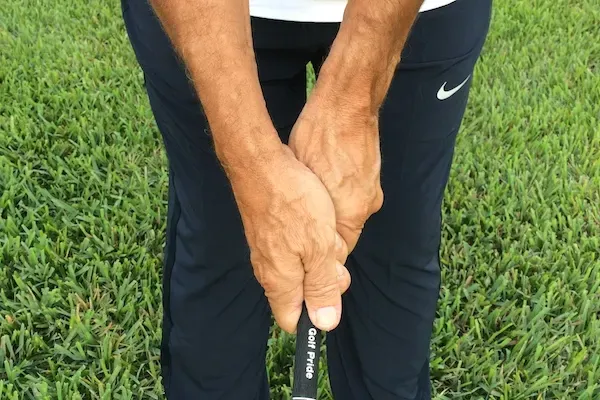
The Weak Grip
Tour Prevalence: 10%Both hands rotated counter-clockwise (to the left). The 'V' points toward the chin or lead collarbone. Very rare in modern golf.
- Jordan Spieth (PGA)
- Ben Hogan (PGA)
- Celine Boutier (LPGA)
The 4 Pillars of Grip Mastery
Start Neutral or Baseline
Before introducing variables, master the standard neutral position (2 knuckles). Over 90% of golfers never correct this. A neutral grip ensures you are not building a swing around a physical fault.
Finger Seating Over Palm
Lay the grip diagonally across the base of the fingers, not straight across the life-line in the center of your palm. Palm grips immobilize the wrist hinges and destroy your ability to create clubhead speed.
The 60-Second Mirror Audit
Grip positions subtly morph over 18 holes due to sweat, tension, and fatigue. Establish a pre-shot grip protocol with a mirror at home to visually verify knuckle exposure matching your target flight.
Micro-Personalization
Never change the grip macroscopically. If fighting a stubborn slice, turn the lead hand rightward just 1/4 of an inch. A tiny change feels massive in the hands, but translates to enormous face angle closing.
Golf Grip Mechanics Knowledge Base
Answers straight from the launch monitor studios and PGA coaching manuals.
What is the mechanical difference between a strong and weak golf grip?expand_more
Which grip directly helps fix a chronic slice?expand_more
How many knuckles should I see at address?expand_more
Should I use an Overlapping (Vardon), Interlocking, or Baseball (10-Finger) grip?expand_more
How tight should I hold the golf club?expand_more
Lock This Guide to Your Training Archive
Add this graphical cheat sheet directly to your bag for on-the-range reference.